



Stockholm City Streamlines Cycling Network Inventory with TNE Editor
Municipalities responsible for planning, developing and maintaining cycling infrastructure need more detailed information about their networks than what is available in the Swedish National Road Database (NVDB). In spring 2026, the City of Stockholm inventoried approximately 680 kilometres of its cycling network using TNE Editor, based on the road network already registered in NVDB.
The challenge
The City of Stockholm’s Traffic Office carries out ongoing investments in infrastructure and needs to collect and maintain data about the city’s road network, both in-house and with the support of external consultants. Previous inventories had not been linked to the NVDB network, but were instead stored using separate geometries. As the road network changed over time, the data gradually diverged from NVDB, making it increasingly difficult to maintain.
Before carrying out the cycling network inventory, the city reviewed the available technical options and determined which information needed to be recorded, including cycling infrastructure type, width, surface material and separation from pedestrian traffic. One requirement was that an external party should be able to carry out the inventory while the Traffic Office could monitor the work and access the results as the work progressed.
The solution
The City of Stockholm already uses TNE Editor to update and submit road data to NVDB; see our previous news article. The inventory could therefore be based on the cycling network already registered in NVDB, rather than requiring the geometry to be digitised from scratch. A dedicated data catalogue was set up in the TNE environment for the city’s own data.
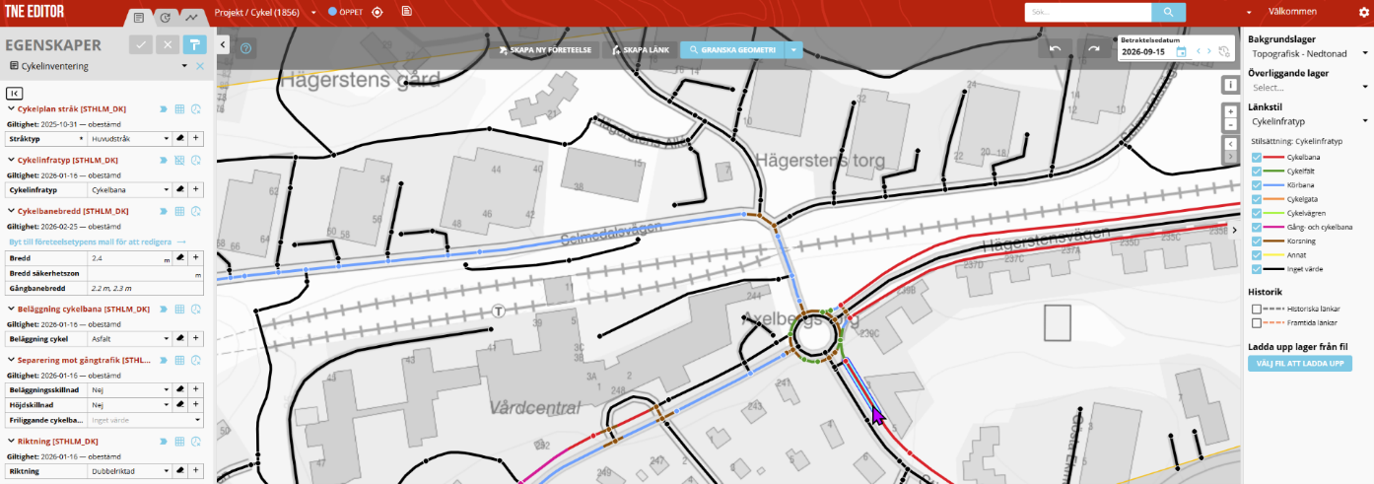
With TNE Editor, the City of Stockholm can:
- Define custom feature types based on the city’s specific requirements, such as cycling infrastructure type, cycle lane width, surface material and designated cycling routes
- Link information to the existing road network rather than creating a parallel cycling network
- Import survey data and link it to the existing network
- Use templates with predefined values to make data collection more efficient
- Have an external party carry out the inventory
- Monitor the work continuously through map services
- Analyse and export the collected data
The inventory was carried out by Sweco, while the Traffic Office was able to monitor the work throughout the process.
"The use of data catalogues enables us to work with the information ourselves in a structured way. By starting from the road network we already have in NVDB, we could focus on linking information to the existing network instead of redrawing the cycling network. The information from the cycling inventory can then be combined with information from NVDB when it is used and analysed." Oskar Sirland, Analyst, Traffic Office, City of Stockholm
The results
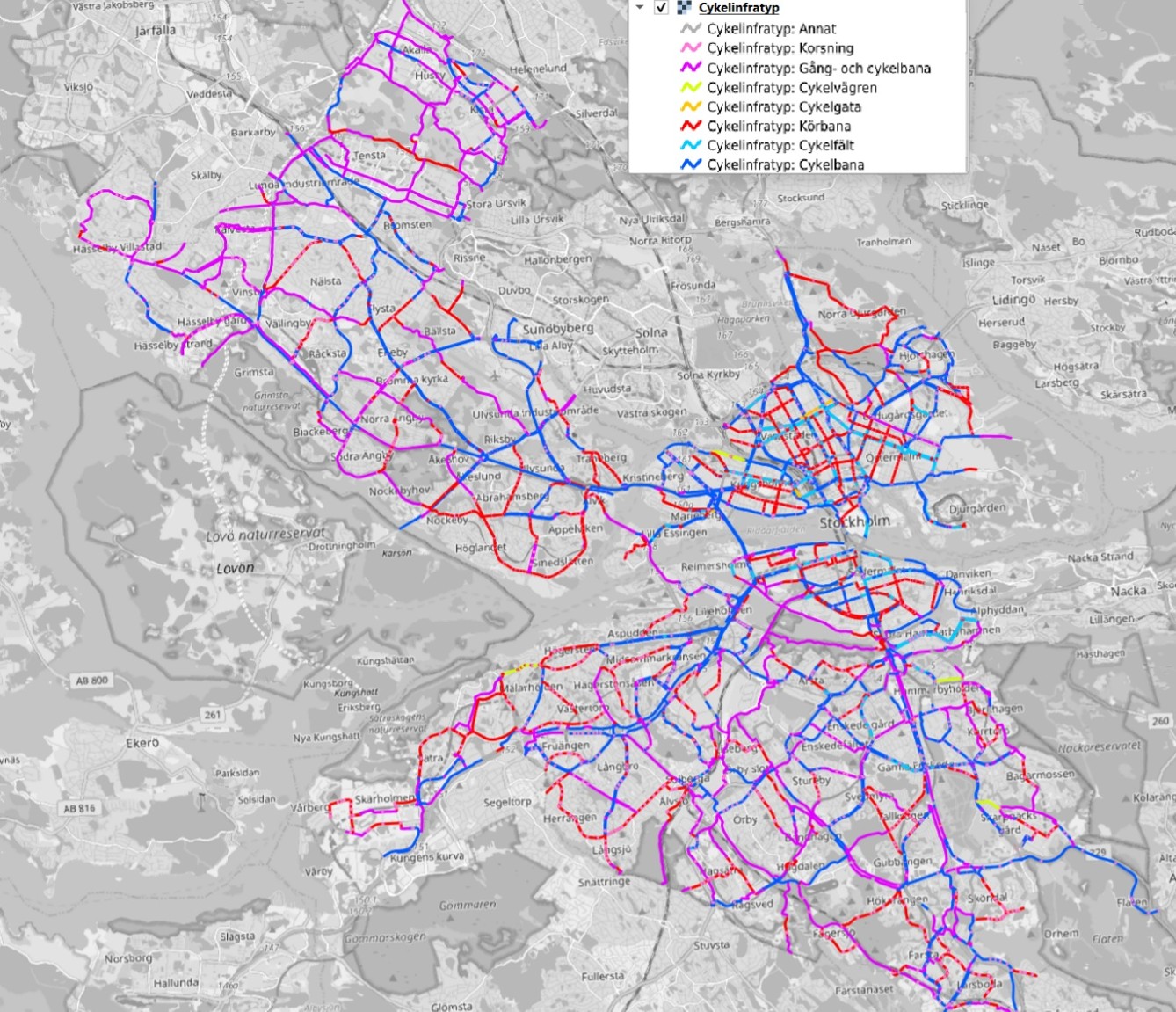
The inventoriedta collection: Using an existing cycling network from NVDB as the starting point, combined with templates during data collection and the ability to import survey data and match it to the existing network, made the inventory more efficient than the city’s previous inventories.
Improved data for NVDB: The inventory also identified gaps and inaccuracies in NVDB. The information was passed on to the city’s NVDB data managers. Since the work was carried out in the same tool the city uses to update NVDB, the corrections could also have been made directly in TNE Editor if desired.
Validated and shareable data: TNE includes functionality for validating data and combining the results with data from NVDB. This makes it easy to validate and export data according to the city’s requirements.
"By using TNE Editor to manage the inventory data, we were able to make our work significantly more efficient. We did not have to redraw the cycling network, and we could review the work using advanced quality controls that were continuously updated." Joel Persson, Transport Planner, Sweco
Customer: City of Stockholm, Traffic Office
Industry: Transport infrastructure
Scope: Inventory of approximately 680 kilometres of cycling network in spring 2026
Challenge: The city needed more detailed information about its cycling infrastructure than what is managed in NVDB, as well as tools for modelling and managing this information.
Solution: Using TNE, the city can define the information it needs and collect it in TNE Editor. TNE Editor provides functionality for importing source data, as well as support for templates and validation, significantly streamlining the process.
Keywords: cycling infrastructure, NVDB, TNE, TNE Editor, road data, cycling network
